Short answer: Predictive analytics and AI project management help event teams catch problems early. Risk scoring, dependency monitoring and alerts give time to respond.
- AI monitors project data, vendor updates and task completion for early warning signs.
- Predictive alerts and risk scoring show which problems matter most.
Human oversight stays in place: AI flags a risk, and the event manager decides how to respond.
- 1. Why are event risks often discovered too late?
- 2. Why is manual risk tracking not enough?
- 3. The 5 ways AI predicts event problems
- 4. What event risks can AI help detect?
- 5. How do the 5 AI capabilities compare?
- 6. How should an event company start using AI risk prediction?
- 7. What is the biggest mistake event companies make?
- 8. Why does this matter for Saudi Arabia and the UAE?
- 9. How does Ewaantech help event companies build predictive risk systems?
- 10. Frequently asked questions
In event management, problems rarely stay isolated. One delayed dependency can affect several downstream activities. A vendor delivery delay can affect setup. A setup delay can affect technical testing. A testing delay can affect rehearsal. A rehearsal delay can affect event opening. By the time the team notices the problem, the event may already be under pressure.
This is why event operations need more than checklists. They need predictive visibility.
Event managers are usually skilled at spotting risks from experience. They know which suppliers need close follow-up, which approvals often take longer, which venue rules can cause delays, and which tasks must be completed before others can begin. But when a team is managing multiple vendors, timelines, documents, and internal approvals, even experienced managers can miss early warning signs.
AI can help by continuously monitoring event data, supplier updates, task completion, schedules, and dependencies to identify risks before they disrupt the event. In practice, this combines predictive analytics with AI project management, applied to the event lifecycle.
Why are event risks often discovered too late?
Event risks are often discovered too late because event teams rely on manual checking, and if one update is missed, the risk stays hidden.
A large event has many connected activities. Consider a simple workflow: venue access, supplier delivery, technical setup, testing, rehearsal, and event opening. If venue access is delayed by two hours, supplier delivery may be delayed. If supplier delivery is delayed, technical setup begins late. If setup begins late, testing is rushed. If testing is rushed, rehearsal may be compromised. If rehearsal is compromised, the event team enters showtime with uncertainty. This is how one dependency can affect the entire event chain.
Event teams often rely on manual checking. Someone calls the vendor, someone checks the spreadsheet, someone reads the email thread, someone updates the production sheet, and someone follows up with the venue. Salesforce’s event management documentation describes event workflows as structured stages with operations, validation checks, and lifecycle movement from drafting to execution. This shows why event operations need process visibility, not just informal coordination.
Why is manual risk tracking not enough?
Manual tracking works when events are small, but as events grow, the number of dependencies increases.
A single corporate event may involve venue access, catering, AV, lighting, security, printing, branding, registration, transport, protocol, photography, content, permits, guest management, and sponsor deliverables, each with its own timelines and dependencies.
Manual checking becomes risky because information is distributed across people. One person may know about a delay, but the rest of the team may not. A vendor may mention a problem casually in a chat, a permit may still be pending in email, and a supplier may not confirm delivery until the last minute. Event managers often find out only when something becomes urgent.
This is the gap that event risk management software and AI-based risk management software are meant to close. AI can monitor signals continuously and surface risks earlier.
How can predictive analytics monitor event project data?
An AI-enabled event operations system can connect with project plans, task boards, vendor updates, emails, documents, spreadsheets, forms, and communication channels. It can track whether key tasks are complete, whether deadlines are approaching, whether dependencies are blocked, and whether vendor updates indicate delay. For example, AI can monitor:
- Vendor confirmation status
- Delivery timelines
- Approval deadlines
- Pending client feedback
- Permit status
- Task ownership
- Setup schedules
- Missing documents
The system does not need to make decisions independently. It can act as an early-warning layer that alerts the team when something needs attention.
What are predictive alerts for event teams?
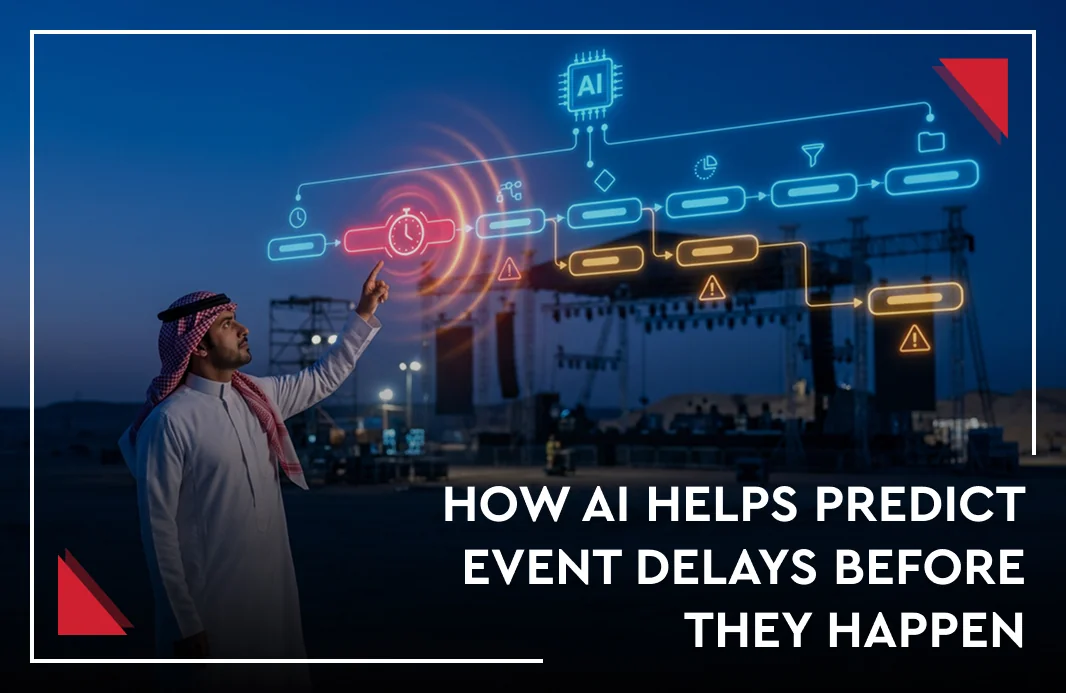
A predictive alert is different from a normal reminder: a reminder says, “This task is due tomorrow,” while a predictive alert says, “This task is delayed and may affect three downstream tasks.”
If stage design approval is pending and printing depends on it, AI can warn that print production may be delayed. If vendor delivery is not confirmed within the expected window, AI can flag setup risk. If two teams schedule setup in the same venue zone at the same time, AI can detect a scheduling conflict.
These alerts help event managers act earlier. They can call the vendor, adjust the schedule, assign another team, request approval, or prepare a backup plan. The value is not only in predicting the problem. The value is in giving the team enough time to respond.
What is dependency monitoring in event operations?
Dependency monitoring is one of the most important use cases of AI in event operations, because every event has task relationships.
A stage cannot be installed before venue access is granted. Lighting cannot be tested before rigging is complete. Registration cannot open before badges are printed. Food service cannot begin before guest count is confirmed. AI can map these dependencies and identify which incomplete tasks may cause downstream delays. This is the event version of dependency management software: instead of seeing tasks as independent checklist items, teams see the event as a connected workflow.
Gartner has described multiagent systems as a new era in AI-driven enterprise automation where specialized agents can work on modular steps and coordinate complex workflows. For event operations, this idea is useful because different agents could monitor vendors, approvals, schedules, documents, and risk signals as separate but connected workflows. This is the practical direction of agentic AI in business operations.
How does risk scoring work for event operations?
AI can support risk scoring by calculating risk based on urgency, dependency, deadline, vendor reliability, and event impact, instead of treating every pending task the same. This is the foundation of predictive risk management and event risk assessment. For example:
- A late branding approval may be medium risk if printing can still happen.
- A missing venue permit may be high risk if setup cannot begin without it.
- A delayed technical supplier may be critical if testing depends on them.
Risk scoring helps teams focus attention where it matters most. Event managers do not need more alerts. They need better alerts. A system that flags everything creates noise, while a system that prioritizes risks creates clarity.
How do escalation and decision support work?
Once AI identifies a risk, the next step is escalation: the system can notify the responsible person, suggest possible actions, or route the issue to a manager.
If a vendor has not confirmed delivery, the system may recommend follow-up. If the delay affects rehearsal, it may escalate to the operations head. If the risk involves budget or vendor replacement, it may require human approval. This matters because event operations involve money, relationships, brand reputation, safety, and client expectations. AI should support decision-making, not remove accountability.
What event risks can AI help detect?
AI can help event teams detect several types of operational risk, which gives them a stronger way to manage uncertainty.
- Vendor delivery delays
- Missing approvals
- Scheduling conflicts
- Incomplete setup tasks
- Permit delays
- Budget approval delays
- Conflicting venue access times
- Unassigned responsibilities
- Repeated follow-up gaps
How do the 5 AI capabilities compare?
Each capability covers a different step, from monitoring data to supporting decisions.
The 5 ways AI predicts event problems
| AI capability | What it does | Who needs it | Key features |
| Monitoring project data | Tracks task completion, deadlines, blocked dependencies and vendor delay signals | Event teams | Project plans, task boards, vendor updates, emails, documents, spreadsheets, forms |
| Predictive alerts | Warns when a delayed task may affect downstream tasks | Event managers | Print production, setup risk and scheduling conflict warnings |
| Dependency monitoring | Maps task relationships and finds incomplete tasks that may cause delays | Event teams | Connected workflow view of venue access, rigging, badges, guest count |
| Risk scoring | Rates risk by urgency, dependency, deadline, vendor reliability and event impact | Event managers | Medium, high and critical ratings |
| Escalation and decision support | Notifies the responsible person, suggests actions or routes issues | Managers and operations heads | Follow-up recommendations, human approval for budget or vendor replacement |
How should an event company start using AI risk prediction?
Start with clean operational data, because AI risk prediction needs accurate task lists, vendor timelines, approval rules, and dependency mapping.
- Clean the data: accurate task lists, vendor timelines, approval rules, and dependency mapping.
- Set up integrations, because event data is often spread across emails, WhatsApp, spreadsheets, project tools, and documents.
- Set permissions, since vendor contracts, budgets, client communication, and internal notes may require different access levels.
- Monitor risks across the whole event lifecycle: planning, supplier sourcing, approvals, production, setup, testing, rehearsal, and showtime.
- Keep human oversight: AI may flag a risk, but the event manager should decide how to respond.
Gartner’s guidance on agentic AI highlights that weak data foundations, architecture issues, overestimating reliability, and insufficient change management are common reasons AI pilots fail.
What is the biggest mistake event companies make?
The biggest mistake event companies make is treating risk management as a final-stage activity.
If risks are only reviewed one day before the event, it is often too late to respond properly. Risk monitoring should happen throughout the event lifecycle, and every stage should have visibility. AI can support this by continuously monitoring signals and surfacing potential problems early.
Why does this matter for Saudi Arabia and the UAE?
Event teams in Saudi Arabia and the UAE often have one company delivering several events across Riyadh, Jeddah, Dubai, and Abu Dhabi at the same time, which is when even experienced managers can miss early warning signs. The future of event operations, in the UAE, Saudi Arabia, and beyond, will depend on better visibility, predictive alerts, and connected systems that help teams act before problems disrupt the event.
How does Ewaantech help event companies build predictive risk systems?
At Ewaantech, AI-powered event risk prediction can be built as a workflow intelligence system for event companies in Saudi Arabia and the UAE.
This may include custom AI development, vendor workflow integration, task monitoring dashboards, dependency mapping, predictive alerts, approval workflows, and decision-support systems. Ewaantech can help event companies connect existing tools, including event management software, and build AI systems that detect risks before they become visible problems. The goal is not to create more complexity. The goal is to give event teams a clearer view of what may disrupt execution.
Frequently asked questions
What is the difference between a predictive alert and a reminder?
A reminder says, “This task is due tomorrow.” A predictive alert says, “This task is delayed and may affect three downstream tasks.” The value is in giving the team enough time to respond.
Does AI make decisions for event managers?
No. The system does not need to make decisions independently. It can act as an early-warning layer, and if the risk involves budget or vendor replacement, it may require human approval.
Why is risk scoring useful for event teams?
Event managers do not need more alerts. They need better alerts. A system that flags everything creates noise, while a system that prioritizes risks creates clarity. Events are time-sensitive, dependency-heavy operations, and one missed approval, delayed vendor, or incomplete setup task can affect several downstream activities.
Sources Used
- Salesforce: How Event Management Works. Salesforce
- Gartner: Multiagent Systems and Enterprise Automation. Gartner
- Gartner: Agentic AI ROI and Pitfalls. Gartner